
What does it take to create lasting change?
Volunteers from across Collegiate Cambridge came together to explore the University’s future and the role they play in shaping it.
On a warm June afternoon at the Sainsbury Laboratory, with the Cambridge University Botanic Garden just beyond the glass, the second annual Volunteer Summit brought together members of Cambridge’s volunteer community for a moment of connection and perspective.
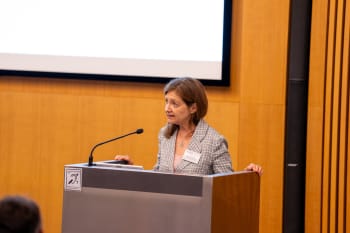
Opening the event, Vice-Chancellor Professor Deborah Prentice set out a clear and candid view of the landscape.
She explained that Cambridge remains globally strong, but the context is shifting: funding pressures are tightening, costs are rising, and choices are becoming more complex.
Against this backdrop, the importance of relationships, with alumni, donors and volunteers, came through not as an abstract idea, but as a practical reality shaping how the University moves forward.
From there, the conversation widened.
Roland Sinker, Chair of the Inclusive Innovation and Growth Review, reflected on Cambridge’s innovation ecosystem: its capacity for discovery, its global partnerships, and its ability to bring people and ideas together.
The question was not simply what Cambridge has achieved, but what it does next and who helps to make that happen.
Within this, volunteers occupy a distinctive space: connecting the University and Colleges to the wider world through their networks, insight and influence.
Later in the afternoon, the focus shifted to the motivations behind volunteering itself.
In conversation, Lord Woolley of Woodford, Principal of Homerton College and founder of internationally renowned campaigning NGO Operation Black Vote, and Professor Sander van der Linden, Professor of Social Psychology in Society and Director of the Cambridge Social Decision-Making Laboratory, explored why individuals choose to act and how change happens.
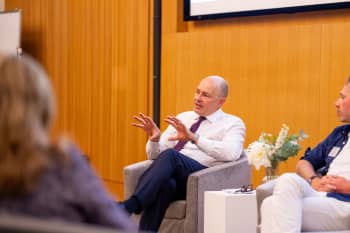
A recurring theme was agency.
Social impact, at its best, is not about obligation, but about belief: the sense that individual action can contribute to something larger.
There was also a note of realism. Not all engagement is equal, and not all impact is immediate.
Some of the most visible forms of participation such as the ALS Ice Bucket Challenge, can generate rapid awareness but fade quickly.
By contrast, sustained engagement, the steady, often less visible work of building relationships and sharing expertise, is what ultimately creates lasting change.
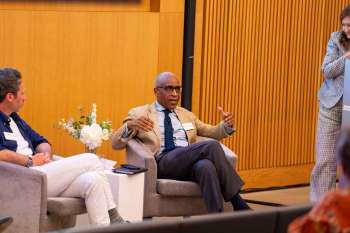
At the same time, moments of collective momentum still matter.
The example of Greta Thunberg highlighted how people are often moved to act when they see others doing the same, when participation feels both visible and effective.
Across the afternoon, questions from the audience reflected this balance between ambition and practicality.
How can Cambridge better connect its global community? How can volunteers contribute in ways that feel meaningful and effective?
And how does a complex, decentralised institution translate insight into action?
There were no single answers and perhaps that was the point. The Summit did not seek to resolve these questions, but to surface them, and to place volunteers firmly within that conversation.
What was clear, however, was the strength of the community itself. Bringing together individuals with deep experience, long-standing commitment and a shared interest in Collegiate Cambridge’s future, the event reflected a growing and engaged volunteer network.
As the Summit closed, the sense was not of conclusion, but of momentum. This is a community still evolving, and an opportunity to build more connected, sustained and meaningful engagement in the years ahead.