All roads lead to Widening Participation
How Abigail Williams’ engagement with outreach at Cambridge has shaped a PhD, a career and a lifelong mission
Abigail Williams (Homerton 2022) firmly believes that education should be accessible to everyone. Inspired by her own experiences, she now aims to empower young minds and inform wider education policies.
This seed was planted during her early interactions with outreach initiatives, sprouted through the Opportunity Studentship at Cambridge, and is now bearing fruit as she maps her research, volunteer work, and professional goals.
The Cambridge Opportunity Studentships are for master's students from low-income households with experience of educational disadvantage, who are set at the Home rate for fees. The scholarships are intended to cover University fees and living expenses when the maximum postgraduate grant or loan is taken with government student finance.
The Opportunity Studentship was made possible partly thanks to a significant legacy left by Rosalie Crawford. Abigail was inspired by her story: "Not only did it show me the impact of education and the transformative way it works in people’s lives, but I was also struck by her passion for her mission and her career."
The Cambridge Trust has been integral in enabling students like Abigail to receive this scholarship, managing various sources of funding, leading the awarding process, and, more recently, contributing funds to support its continuation.
The Opportunity Studentship provided vital financial assistance for Abigail to excel in her degree and to thrive in Cambridge’s rich academic and social environment.
Learning about university through outreach
Born and raised in north London, Abigail attended an all-girls Catholic state school. “I considered going to university as I was quite academic, but I wasn’t sure where to start.”
Then, she had her first taste of what outreach initiatives could provide: “I attended a Year 11 summer school at London School of Economics (LSE). I realised how important it was to gain exposure to what universities were like as my mum hadn’t been to university and my school’s ability to guide me through the application process was limited.”
The outreach programmes not only boosted Abigail’s confidence but also made her want to maximise the impact of these schemes to help others. “The programmes inspired me to apply to university and got me interested in doing outreach work myself.”
After completing her undergraduate history and politics degree at LSE, Abigail’s thoughts turned to doing a master's degree to apply her academic training and knowledge in the context of education. Cambridge fit the bill: “I liked that the Education course at Cambridge had a blend of global perspectives.”
Initially, Abigail was unsure as to whether she would fit in at Cambridge: “But, seeing different influencers on social media who went to Cambridge from a similar background to me made it seem more achievable.”
Abigail at her MPhil graduation
Abigail at her MPhil graduation
“[Outreach] programmes inspired me to apply to university and got me interested in doing outreach work myself.”
Abigail and her mum with Simon Woolley
Abigail and her mum with Simon Woolley
“Going to a College that shared the same drive to support underrepresented students as the University did make me feel like it was a safe space.”
A place to call home
Abigail applied to the Opportunity Studentship whilst completing her general application to Cambridge.
“All I had to do was give some information about my experience of my undergraduate degree; any challenges I’d faced; and why I was suited to the course.”
This scholarship not only enabled Abigail to come to Cambridge, but it also reassured her that it would be a welcoming environment.
“Practically speaking, I needed the funding. But it also signalled to me that Cambridge was reaching students who have been historically underrepresented.
"This aligned with my own beliefs about the role of widening access in the future of higher education.”
Abigail experienced Cambridge’s openness as soon as she stepped foot in Homerton College. “I bumped into Simon Woolley, the Principal of the College, during a graduation ceremony.
He said to me “You really do belong here”. It truly stuck with me, as I was coming into an environment that was intimidating, but at the same time was also welcoming.”
Networks of support at Cambridge
Help at Cambridge went well beyond finances. “Having welfare support available to me during my master’s was invaluable. It was good to have someone to vent to about anything when times were tough.”
Abigail wanted to ensure all students could access this support, and she enacted this through her role as welfare officer for Homerton MCR.
“During a time of crisis, students may not have the time or headspace to navigate the College’s welfare website. So, I helped to create a poster with a flow chart to explain to students the process of applying for welfare support, which we stuck around College accommodation.
"I saw the positive impact it had in terms of helping people to navigate tough times efficiently.”
Support also came through informal networks. “Cambridge Black Postgrad Society was an important resource for me because it joined together people from similar backgrounds.
"Many of us were on scholarships, so it was a supportive space, especially when we were navigating challenging parts of the educational experience.”
Abigail with members of the Ghanian Society Committee
Abigail with members of the Ghanian Society Committee
Abigail with friends at graduation
Abigail with friends at graduation
Abigail at graduation with members of the Cambridge Black Postgrad Society
Abigail at graduation with members of the Cambridge Black Postgrad Society
Abigail at a Higher Education provider visit
Abigail at a Higher Education provider visit
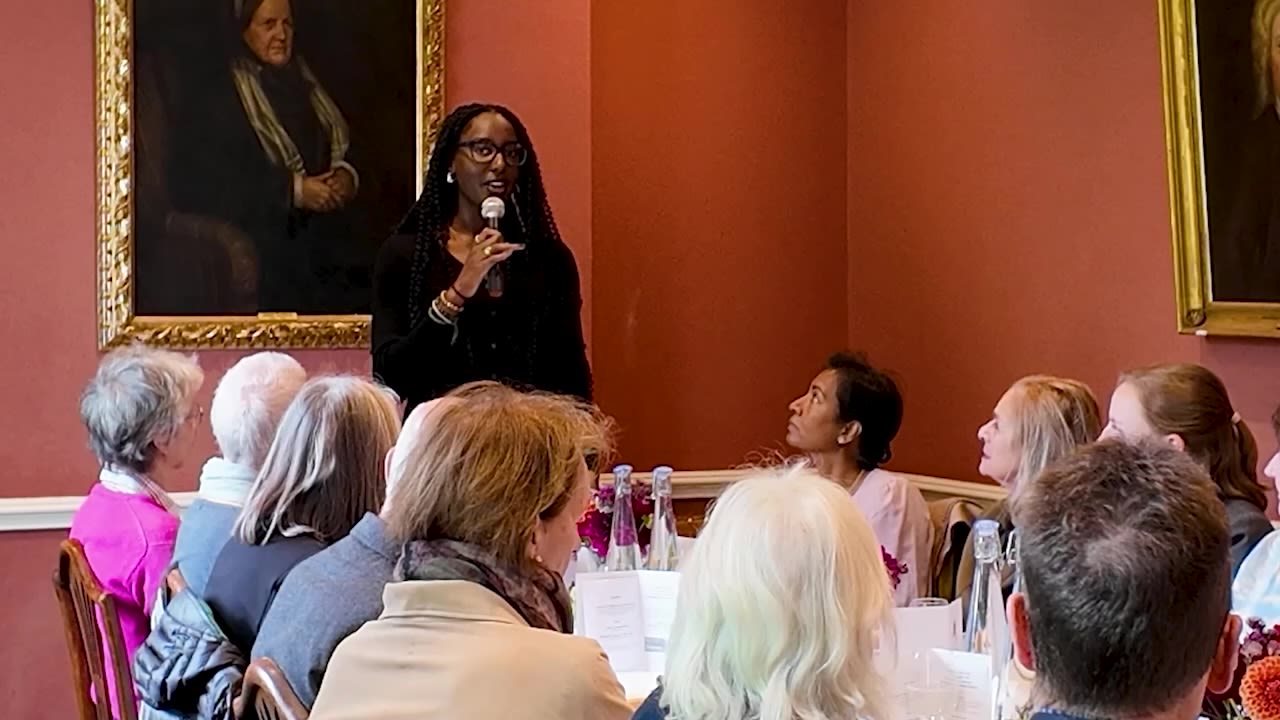
Abigail speaking at a secondary school
Abigail speaking at a secondary school
“I’m hoping my findings can feed back into universities, helping to fine tune access programmes and develop an evidence base for the impact of these schemes.”
Putting words into action
At Cambridge, Abigail expanded her theoretical skills, which then motivated her to pursue a career in education policy.
After graduating, she worked at the Office for Students, England's higher education regulator. “I helped to develop strategies and worked with the Director for Fair Access and Participation with rolling out new projects.
“Working on the Equality in Higher Education Innovation Fund, I conducted training for the assessors and, together, we selected the winning bids from universities for outreach projects based on a scoring system.
There was a bid that I was passionate about that had fallen just below the cut off score. I presented my case to the senior leaders and changed their minds to award the bid funding.
"It taught me to advocate for what I believe in and being confident in my knowledge and decision-making skills.”
Volunteering also plays a part in Abigail’s mission. “I do outreach work with Excelle Network, a charity in North London, running programmes with schools, one of which is my old secondary school. We bring alumni back to talk about their careers and to share their advice.
"I also work with the Social Mobility Foundation as a member of their Youth Advisory Panel.”
She’s using the insights she’s gained from her work at Cambridge and beyond to inform her PhD in Education at Oxford.
“Seeing these challenges on the ground, I’ve realised that universities who are implementing these programmes don’t have the resources to deliver change in the way they want to.”
Abigail’s PhD focuses on the impact of widening participation initiatives on student trajectories.
Ripples of impact
Abigail’s immersion in outreach and widening participation initiatives has given her first-hand experience of the immensely positive effect of these schemes on those facing educational disadvantages.
By taking this forward in her voluntary work, career, and research to inform education policies and encourage everyone to strive for success.
Her story demonstrates the long reach of widening participation initiatives. Transformational experiences like Abigail’s can add up to far more than the sum of their parts, going on to champion and influence others in ever-widening ripples of impact.