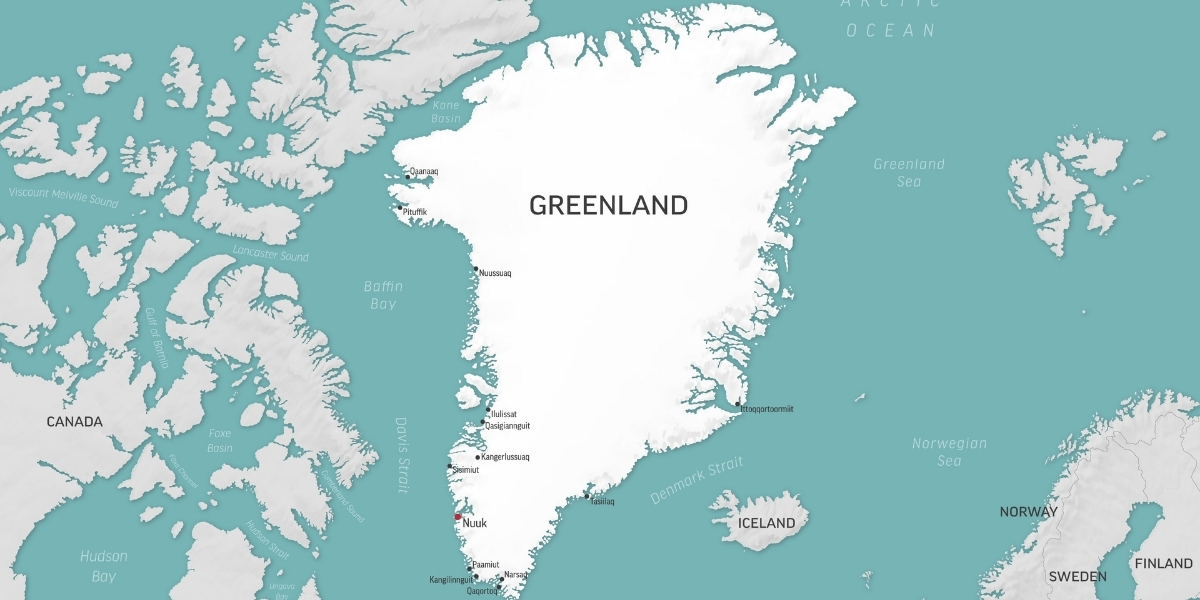
Greenland sits at the frontline of global change. Its vast ice sheet is melting at an unprecedented rate, with profound consequences for global sea level and for the communities who live alongside it. Beneath the ice, Greenland’s rocky landscape preserves a rich record of Earth’s geological history and contains critical mineral resources essential to the global energy transition. At the same time, the peoples of Greenland and the wider Arctic are among the first to experience these rapid environmental changes.
Chaired by Jerome Neufeld, Professor of Earth and Planetary Fluid Dynamics, this webinar brings together three leading Cambridge researchers to explore why Greenland is such a vital natural laboratory for scientific research, highlighting work on its climate, mineral resources, and peoples:
Dr Kelly Hogan, Marine Geophysicist, British Antarctic Survey
Professor Owen Weller-Gibbs, Professor of Metamorphic Petrology, Department of Earth Sciences
Professor Michael Bravo, Professor of the History and Geography of Science, Scott Polar Research Institute
From ice–ocean interactions and climate history, to the geological history of this frozen landmass to the human dimensions of Arctic science, the speakers will reveal how research in Greenland helps us understand our planet’s future, and why it matters far beyond the Arctic.
This session will include short talks and a live Q&A with the speakers, featuring questions from the audience.
Please note: due to exceptionally high demand to join the live session, capacity on Zoom may be limited.
If we reach capacity, you will be redirected to an overflow live stream on YouTube, where you’ll still be able to watch the full event in real time. When watching from YouTube, questions for the speakers can be submitted by replying to your registration confirmation email.