
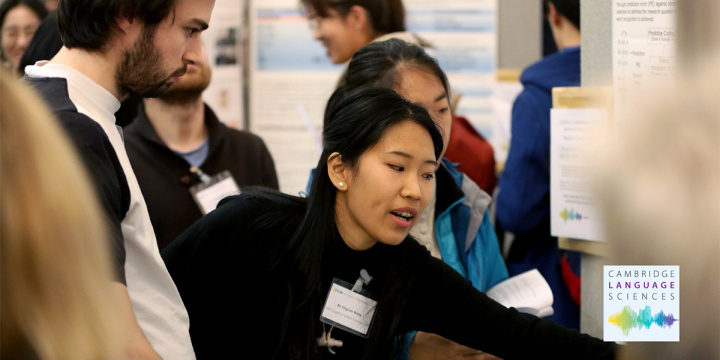
Cambridge Language Sciences (CLS) is one of a select group of University-wide Interdisciplinary Research Centres at Cambridge designed to build research capacity in tackling some of today's greatest challenges. Our mission is to promote dialogue between language scientists of all disciplines — to stimulate innovative thinking and catalyse the formation of new interdisciplinary partnerships for novel research and creative teaching.
The interdisciplinary approach and collaboration between researchers across the Cambridge Language Sciences network strengthens our ability to tackle complex issues in key areas including technology, health, education and society.
We are currently considering a number of ambitious ‘moonshot’ questions which we hope to investigate through long-term interdisciplinary research:
- How can people with diverging views be supported to successfully communicate and negotiate?
The development of new technology has outpaced the evolution of mediation and politeness conventions. Answering this question requires understanding how people communicate and miscommunicate, how disputes can be resolved, and what tools could make these processes smoother.
- How can language use allow us to understand and predict mental health conditions?
Advances in AI are creating new opportunities for personalised healthcare. Answering this question requires understanding the variation in language use between individuals, how this depends on underlying cognitive processes, and how this can be applied in a clinical context to improve patient outcomes.
- What does language diversity tell us about the past, present, and future of humankind?
An estimated 40% of the world's languages are currently endangered, many in areas with high socioeconomic deprivation and at high risk of environmental degradation. Answering this question would mean understanding the history of human populations, how languages are learnt by individuals, and how they change over generations.
- How can learning a second language be made effortless?
The majority of the world's population learns at least one-second language, but even motivated learners typically take thousands of hours of study and practice to reach proficiency. Answering this question requires understanding the process of language learning, which aspects are difficult or effortful, and how this changes with different contexts or approaches to learning and teaching.
More information
Support Cambridge Language Sciences (CLS)
You can donate online or to discuss your philanthropic goals, please contact:
Make a gift now
Make a gift now to support by credit or debit card, or set up a direct debit:
Give nowAssociate Director, Arts and Humanities
- Annabel Edwards
- annabel.edwards@admin.cam.ac.uk
Manager, Cambridge Language Sciences
- Richard Arlett
- ra664@cam.ac.uk