Dr Kamila Maria Jozwik leads a visual cognitive computational neuroscience group at Cambridge, investigating how the brain processes visual information, creates meaning from our surroundings, and why these experiences can differ from person to person, including among those with mental health conditions.
Our lab uses brain imaging, behavioural tasks and computational modelling, including brain inspired AI models (NeuroAI), vision deep neural networks, multimodal models and Large Language Models, to understand where and when behaviourally relevant visual representations arise in the brain and how these representations are computationally implemented.
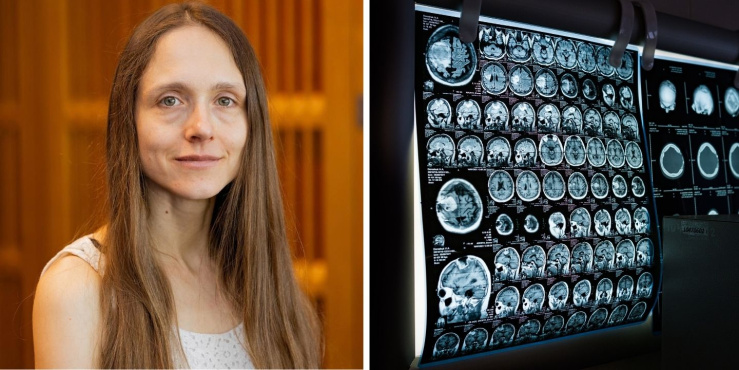
To investigate where visual representations arise, we use functional magnetic resonance imaging (fMRI). To investigate when they arise, we use magnetoencephalography (MEG), electroencephalography (EEG) and electrophysiology.
We are also beginning to use non invasive neurostimulation, known as focused ultrasound stimulation (FUS), to understand the causal role of brain regions in visual perception and to explore the therapeutic potential of FUS.
Most of our research involves collecting data from healthy individuals. However, we have recently expanded our work to include mental health conditions, exploring how visuo semantic perception is affected by phobias, anxiety, depression, psychosis, schizophrenia and obsessive compulsive disorder (OCD).
We are also investigating how generative AI could be used to personalise interventions for people affected by these conditions.
Contact
You can donate online or to discuss your philanthropic support for the Jóźwik Lab please contact:
Make a gift now
Make a gift now to support by credit or debit card, or set up a direct debit:
Give nowHead of Development, Brain and Mind Health
- Belen Tejada-Romero
- belen.tejadaromero@admin.cam.ac.uk