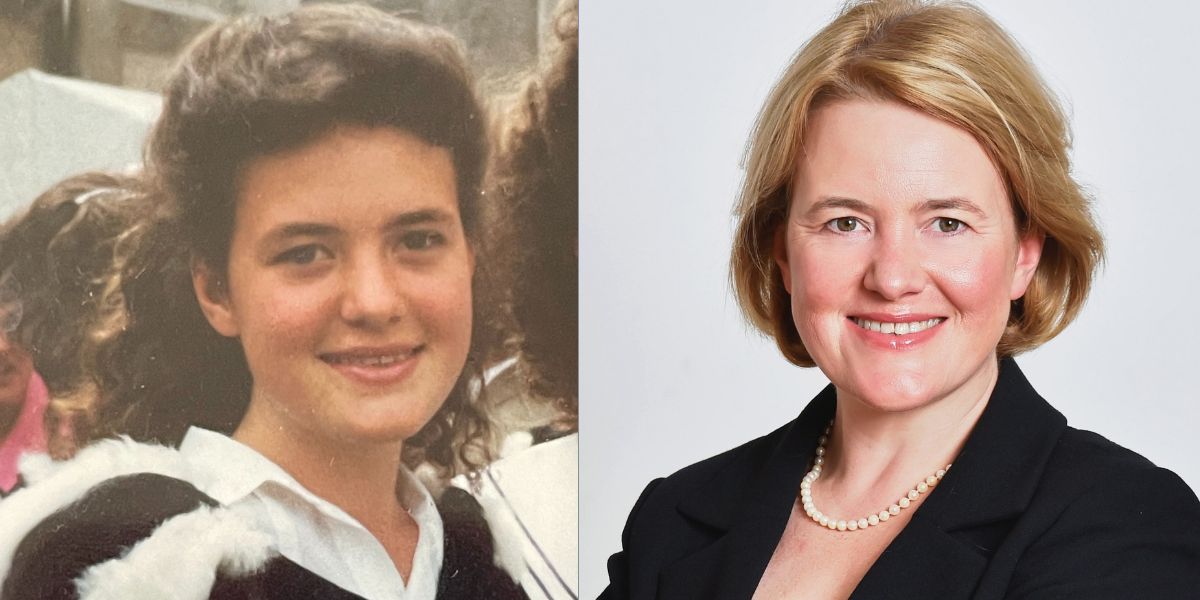
How alumna volunteer Jennifer Haywood celebrates the past and contributes to the future.
London born and bred, Jennifer Haywood’s (Christ’s 1989) ambition to be a doctor led her to study medicine at Cambridge and branch out into zoology in her third year. Now a practising barrister after a career change, she joined Christ’s Alumni & Development Committee in 2018. The Board provides alumni input on development plans and informs other alumni about the latest developments and fundraising needs at Christ’s.
We caught up with Jennifer to find out more:
How did you end up at Cambridge?
I just fell in love with the beauty of the place. I remember going on a church outing to Cambridge and when I was about 13 and thinking: this is so beautiful. I want to come here.
What was your Cambridge experience like?
It was fantastic. I had some ups and downs, of course, but I lived in a beautiful place with people who are still, 35 years later, close friends. The collegiate experience was wonderful partly because I got to meet a broad group of people doing all kinds of different subjects. I suspect that if I had gone straight to a medical school, I would have met a narrower range of people.
Living in College also gave me more time to explore other opportunities. Cambridge is very intense because the terms are short and there is a lot of work to do, and being so well looked after made a huge difference to what else I managed to do. I used to go to open lectures on Italian art, and to English literature clubs and debating clubs. I played sport, too, which was likely easier in this environment because there were College teams and College was so small. It was all about enthusiasm rather than ability at College level, particularly for women's sports. Perhaps I should have been committing myself a bit more fully to my chosen subject, but for me it was all an important part of my education.
Did you graduate with a clear sense of career trajectory? How did this change along the way?
I was convinced I was going to be a doctor. I had been on that trajectory since the age of 14-15. It was only after I had been practising for a few years that I realised I was not enjoying it as much as I had hoped.
Eventually I decided to do a graduate diploma in law, and now I practise as a barrister, specialising in commercial and Chancery law, which is all about business and property. I initially thought I would do medical negligence law because that would be a way into something different that was still familiar. But somebody very wisely gave me probably the best piece of advice I've ever had: only do medical negligence if, in your heart of hearts, you think you would have done it had you not done medicine to start with. In other words, if you're going to change career, don't let the first career determine what you're going to do in the second.
Biggest professional or personal challenge
I think changing careers was my biggest challenge. When you study medicine and become a doctor, that is very much your identity, and everyone assumes that it must be the most satisfying job in the world. It can be very difficult to see yourself in any capacity outside medicine. Giving myself permission to do something else and then identifying what skills I had in medicine that could potentially translate into a completely different role was hard.
What did you learn from Cambridge that has influenced your career and/or shaped who you are today?
It shaped me completely: Cambridge taught me to understand basic principles, question things, and think for myself. The education was rigorous, and I think the tutorial system is enormously valuable because it pushes you to defend your thinking and listen to other people. That training has been useful to me in every part of my life.
What are your aims for the future?
The process of changing careers made me alive to the fact that you should always keep revisiting what you're doing and how you're doing it, so I'm currently focusing more on practising as a mediator and arbitrator rather than as an advocate. I'm still evolving and building up my practise in those areas.
What piece of advice would you give your younger self?
Don't worry if you don't know what you want to do when you're 18. Many of the people I know who are happiest in their careers are doing very different things to what they expected to do when they were 18.
How did your volunteering commitment start? What makes it meaningful or satisfying for you?
I had not been involved with volunteering for any Cambridge institution prior to joining Christ’s Development Board. As a student I worked with a charity called Bridge, which had been set up by some Cambridge students and ran camps and activities for disabled adults and underprivileged children, bringing together two groups with their own specific challenges for everyone to benefit. I got involved with the Alumni & Development Committee by attending College events, through conversations about the College and what challenges it was facing, and I was then invited to join the Committee.
What impact does your College volunteering have? Is there an initiative or achievement you are particularly proud of?
Christ’s finds it helpful to have a view from alumni who are working outside of the University. Our role is bi-directional—partly to give advice and support to the development team; and partly to be outward-looking on the College's behalf and speak to potential donors or act as an ambassador for the College. Both aspects are so interesting and rewarding. I hope that I am helping the College, even in a small way, to relay to other alumni what's going on and what challenges the College is facing.
It’s been a huge privilege and an absolute pleasure to go back to College to meet staff and other alumni on the Committee. Particularly in Covid, it was incredibly humbling to see the immense efforts that Christ’s was making to get everybody through it and build a strong sense of community in the face of the obstacles.
Do you volunteer for causes in other sectors at Cambridge or outside of the Collegiate University? How do you choose your projects?
Like most barristers, I do some pro bono work and educational outreach. I think that is how I can use my skills and experience best. I enjoy helping aspiring barristers with careers advice, applications, and Inns of Court training.
Why is it important to you to give back?
I believe education and research are fundamentally important, to individuals and to the broader community. As an individual I benefited enormously from my education, from other people’s time and advice, and from the Cambridge experience. I know that my Cambridge experience was only possible because of all the previous generations of benefactors, from the people who founded a College like Christ's original benefactor Lady Margaret Beaufort, to everybody who has donated money over the years. I would have had a very different experience without them.
Doing what I can to give a little bit back is important to me. We're all part of an unbroken line of giving and of thinking about the future and the next generation.
What about the idea of ‘giving’ as not having to be about large sums of money or even money at all but rather about time, effort, and expertise?
Everybody has something to give. It’s enormously important for any institution to have outside views and not just be in an echo chamber. The more input Cambridge gets from diverse people doing different things and providing support and advice, the better.
There is perhaps a common misapprehension that everyone at Cambridge has everything sorted and has all the knowledge they need to thrive beyond university. On the contrary: students always need support, advice, and help and there are lots of ways people can get involved.
What advice would you give to someone who wants to get involved in volunteering and make a difference but doesn’t know how to make the most impact, or even where to begin?
Go talk to people. Maybe go to some events or read the information that the University, your College, or your department produces. Reach out to someone if you see something you are interested in.
Perhaps this is an alternative piece of advice I would offer to my younger self: people are always more willing than you think to be approached and to help.
Find out more
Inspired by Jennifer's outlook and generosity? To find out more about volunteering at Cambridge, contact your College or visit the alumni website.