
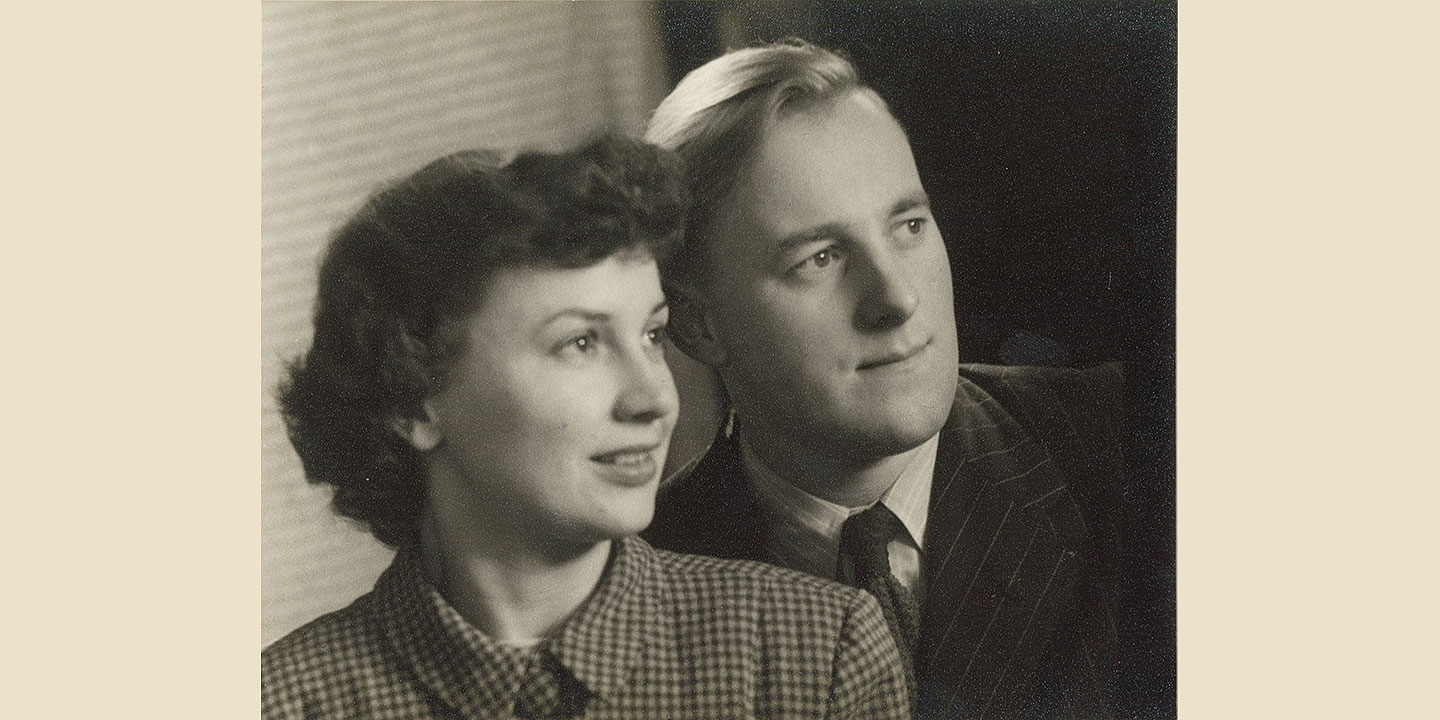
Professor Jennifer S. Read shares the story of a passionate family tradition of philanthropy and high hopes for its impact

Every journey in pursuit of education is unique, and where you start is no guarantee of the outcome. Timing, societal obstacles, and private challenges all play their part in crafting each deeply personal chronicle, and few accounts are more vivid than that of Raymond Read.
The late Professor Raymond C. Read (Selwyn 1941) clung to the promise of education to overcome personal hardships and fought an individual battle for knowledge, community, and stability. And at a time in history when certainties were turned upside-down, his tenacity, resilience, and keen intellect helped him build a thriving career as a renowned thoracic surgeon, create a rich family life, and leave a lasting and inspiring legacy across medicine and education.
Shaped by war and loss: beginnings
Born and raised in London, Dr Read lost his mother when he was 15 years old. Then, at the outbreak of World War II, both of his brothers were drafted. The Trustee of the Read-Gostick Education Fund, Jennifer S. Read MD, the daughter of Raymond C. Read and Lillian J. Gostick, takes up the extraordinary narrative:
"During the Blitz, he was in secondary school, but even at that tender age, he was on bomb patrol: he would be on duty on the roof of the school at night, and if a bomb fell, he would help put the flames out. He lived through the Blitz, escaping harm even though multiple houses in his neighbourhood were bombed and friends and neighbours died. His headmaster was killed. His French teacher joined the French resistance. This was teenage life for my father, and those early experiences really affected him."
Professor Jennifer Read recalls her father’s stories of an isolated College life: "I remember his describing that his dorm room at Selwyn looked directly across at the clock, and he would just study and look at the clock and then study some more. That was his life. Then his older brother, who was in the RAF and stationed nearby, was killed when his plane was shot down over the North Sea. So, he lost his mother and then his brother, and finally, his twin brother was wounded and disabled in the war.
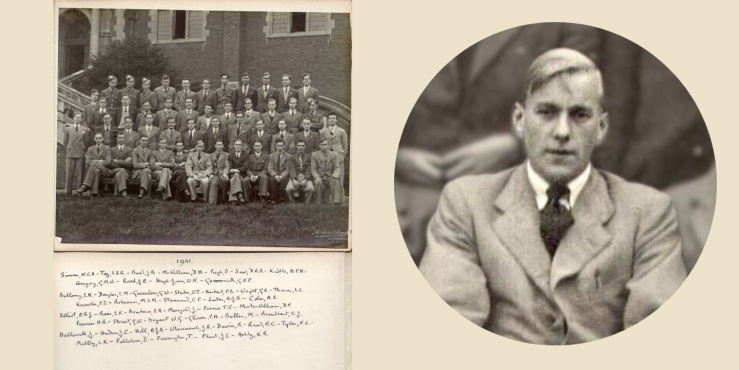
Selwyn College matriculation, 1941, featuring Dr Raymond C. Read
My father felt extremely lucky. He knew his fate would have been the same as his brothers if he hadn’t received a scholarship from Selwyn. In the context of the horrors of war and tragic personal loss, the University and Selwyn became his family and community. All my life, he spoke about this. The inspiration behind the gift for the studentship is simply this very strong connection that my father felt towards Cambridge and specifically Selwyn, and his gratitude for the education that fundamentally changed his life."
A transatlantic odyssey
Raymond Read completed his first degree at Cambridge, earning first class honours in both parts of the Natural Sciences Tripos in 1943 and 1944, as well as the College Prize for Natural Sciences in 1943. He distinguished himself as captain of the Hockey Club and was awarded full colours in 1942; he was also secretary of the Cricket Club (the College calendar reports upon ‘his brilliant displays behind the stumps’), a member of the Logarithms Society where he presented a paper on ‘Heredity’, and secretary of the JCR in 1943-44. He was then awarded a Rockefeller Foundation scholarship, enabling him to earn his MD at the University of Minnesota. In Minneapolis, he met Lillian, a nursing student, who later became his wife. Following graduation from the University of Minnesota, Dr Read returned to England, Cambridge, and the Collegiate University with Lillian, where he completed his MBBCHIR in 1947 and his MA in 1948. His momentum of academic and professional dedication and notable achievement gathered pace.
Dr Read’s military service had been deferred, but after medical school, he served in the Royal Air Force as a flight lieutenant. He obtained residency training at King's College, London and became a Fellow of the Royal College of Surgeons of England before returning to the US for graduate training at the Peter Bent Brigham Hospital in Boston as the Harvey Cushing Fellow in Surgery at Harvard Medical School. Subsequently, he earned his MS in physiology and his PhD in surgery at the University of Minnesota, where he was a resident in surgery at the University of Minnesota Hospitals and then Chief Resident. Following completion of training, Dr Read became [American] Board [of Surgery]-certified in General Surgery and in Thoracic Surgery and a Fellow of the American College of Surgeons. His career as a general and thoracic surgeon, surgery professor, and medical researcher spanned several decades.
But he didn’t just collect well-deserved accolades. His impact was profound and far-reaching.
A staunch advocate of scientific truths and the importance of education and lifelong learning, Dr Read valued his role as a teacher of the next generations of surgeons. His contributions to medical research are chronicled in over 500 publications during 60 years beginning in 1953. He was a founding member of the Society of Thoracic Surgeons, served as president of multiple professional societies, was a member of the Alpha Omega Alpha national medical honour society, and a recipient of numerous professional awards and both domestic and international lecture invitations. An early anti-smoking advocate, Dr. Read’s research regarding ‘metastatic emphysema’ revealed that chronic smoking could damage connective tissue both inside and outside of the lung.
Larger than life
Dr Read’s contagious zest for life, keen intellect, and strength of character made their mark over his long life of public service and family devotion. He had an insatiable appetite for the written word and thoroughly relished reading his beloved New York Times and puzzling over the crossword, as well as listening to opera and classical music, and playing a challenging round of golf (his Certification from The National Hole-In-One Association was a highlight). Dr Read travelled extensively and remained attached to his cherished England, returning frequently to visit family and friends. Possessed of endless energy and enthusiasm, he lived life to the fullest, and memories of his optimism and wit, matched by his unfailing work ethic and respect for others, are treasured by those whose lives he touched.
Empowering others to build careers and reach for the stars
Raymond C. Read and his wife of 64 years, Lillian J. Gostick, were the first in their extended families to attend university. Now, the educational foundation Raymond Read and Lillian Gostick created, the Read-Gostick Education Fund, is providing a studentship for a PhD student at the University of Cambridge’s Victor Phillip Dahdaleh Heart & Lung Research Institute and Selwyn College. This endowment, with its focus on epidemiology, public health, global health, and infectious diseases, ensures that future generations of researchers will have the opportunity to contribute to important areas of health research, continuing the legacy of academic excellence and global impact embodied by the late Raymond C. Read MD PhD.
Professor Jennifer Read further noted that both of her parents prized the value and fulfilment of education and wanted to encourage and support similar opportunities for others, and “I think they would have appreciated the studentship’s inception, with its connection to Selwyn and the University as a whole.” She hopes the studentship will provide an opportunity for young people who want to pursue a PhD degree and are as passionate about the pursuit of knowledge as her parents were.
And there’s no doubt that, like the Read family, the recipients of the studentship will be of a practical mind, applying a deep concern for humanity through substantial and meaningful advances and innovations.
Professor Charlotte Summers, Director of the Victor Phillip Dahdaleh Heart & Lung Research Institute and Fellow of Selwyn College, expressed her appreciation: "We are immensely grateful to the Read-Gostick Education Fund for this gift, which not only honours Dr Raymond C. Read's remarkable legacy but also reinforces the commitment of Selwyn and the VPD-HLRI to nurturing the next generation of leaders in medical research. The PhD studentship will act to further strengthen the VPD-HLRI as a leading centre for epidemiology, global health, and infection-related research”.
The studentship is expected to attract top talent in the fields of epidemiology, public health, global health, and infectious disease research, further strengthening Cambridge's position at the forefront of these areas of study.
What’s your philosophy of giving? What’s important to you?
If you would like to give to the Raymond C. Read and Lillian J. Gostick PhD Studentship or discuss your own ideas around supporting something special, please contact: