
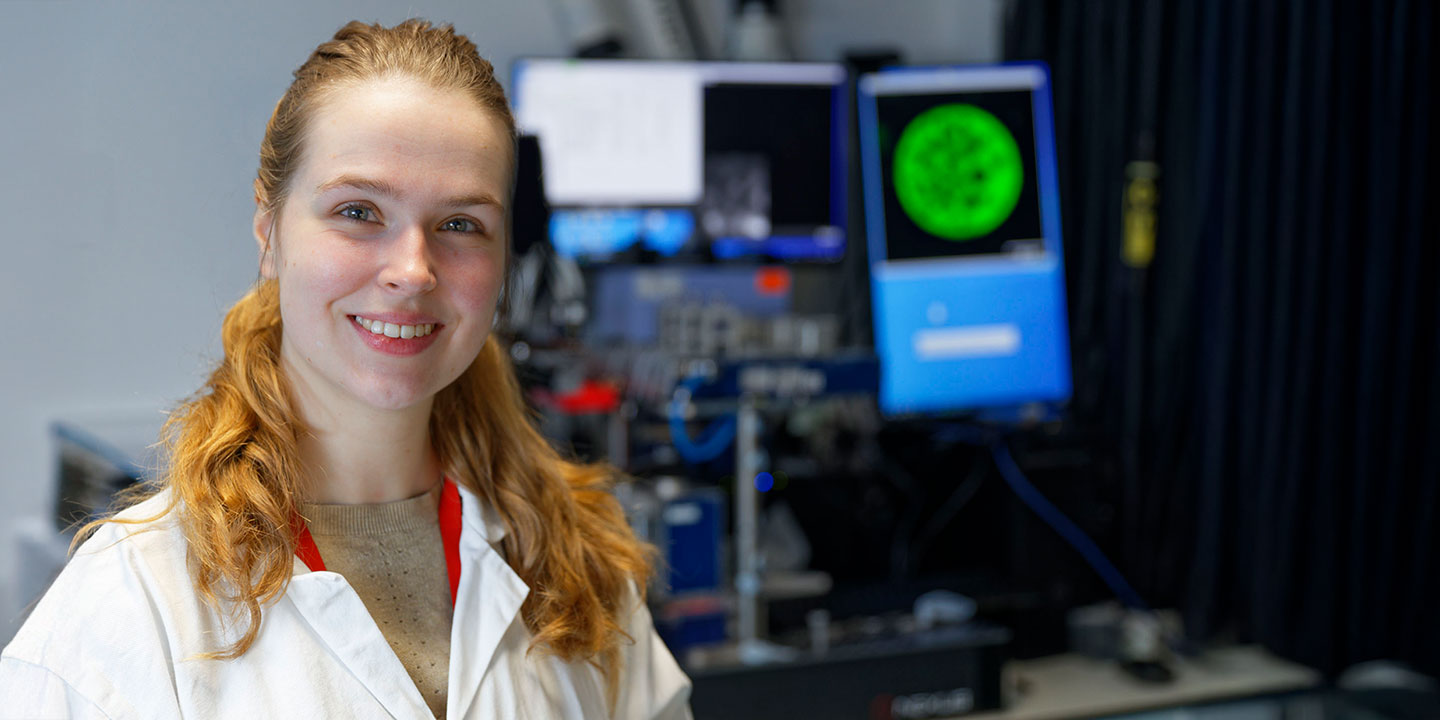
A generous and unrestricted PhD studentship enabled Nadia Erkamp (King’s 2020) to pursue bold, interdisciplinary research into biomolecular condensates, advancing our understanding of neurodegenerative disease and laying the foundations for a promising academic career.

Back in 2021, Nadia Erkamp was starting her PhD journey with a studentship from Sven Royall. Four years on, Nadia’s work is making exciting and impactful contributions by applying biophysics to the field of neurodegenerative disease.
Nadia made full use of the academic freedom afforded to her by her Royall PhD studentship. Based in Tuomas Knowles' lab in Cambridge’s Yusuf Hamied Department of Chemistry, she was able to work for short stints at three other labs, working in medicine, biochemistry, and physics, to explore specific ideas and techniques that enhanced her project on biomolecular condensates. Condensates are liquid compartments in living cells that are contained and distinct from the rest of the liquid cytosol due to their physical properties, rather than having the lipid membranes that surround other cell organelles.
“The field of biomolecular condensates and their function in cells has really taken off during my PhD”, says Nadia.
“Tuomas wanted to explore whether biomolecular condensates, which can be made of proteins, ribonucleotides and other components, had any role in neurodegenerative disease. It is a large and interdisciplinary question, and the reason we were able to make such progress by following whatever direction our experiments required was due to the freedom of my unrestricted studentship."
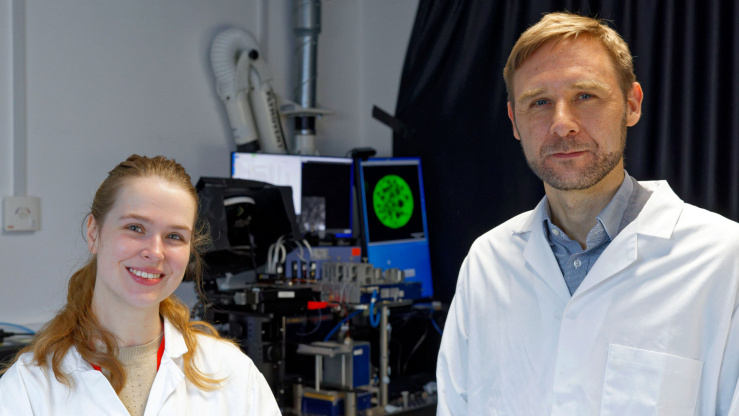
Nadia and Tuomas. Photo: Nathan Pitt
The Knowles group has been using a variety of approaches to study amyloid and fibrils, hallmarks of pathology in several neurodegenerative diseases, including Alzheimer’s, and for her now-completed PhD, Nadia studied whether condensates were involved in the formation of these toxic structures. With colleagues, she developed a new platform that combined microscopy with microfluidics, a system that produces a consistent supply of tiny droplets whose composition and characteristics can be varied experimentally. “We can study 10,000 samples per hour on the platform, and this equipment is in the Knowles Lab now, being used by more researchers working on the biophysics of neurodegeneration.”
Nadia’s work with phase-separation diagrams and measuring the interactions between molecules led her to discover a new way for biomolecular condensates to form complex structures. It was already known that condensates can act as the nucleation sites for the formation of amyloid plaques and fibrils. Nadia’s work to understand and recreate the complex condensate structures was a monumental feat that led to new insights into how amyloid and fibrils might form.
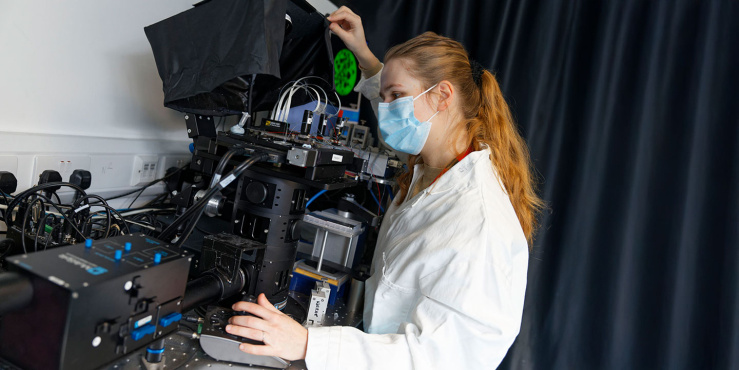
Photo: Nathan Pitt
“When condensates behave like liquids, the cell can make and remove them as needed, but the structurally complex condensates that trigger the formation of amyloid and fibrils lead to their build-up in the cell, disrupting cell function and leading to disease. Sven Royall’s studentship has had an extraordinary impact”, says Nadia. “The research has greatly advanced our understanding of neurodegenerative disease and led to the publication of more than 10 journal papers.
"Sven has enabled me to get an education. I wouldn’t have studied at Cambridge if it weren’t for him, and I believe I wouldn’t have received the offer to run a laboratory at Eindhoven University of Technology if it weren’t for this education.” Nadia has also enjoyed several meetings with Sven over the years to discuss the latest research and his ideas.
In Nadia’s current role at the Eindhoven Institute of Technology as an Institute for Complex Molecular Systems Fellow 2024–2027 and postdoctoral researcher, she is teaching and supervising several students at Eindhoven. As for the future, she is ambitious to land an Assistant Professor position next year and continue blazing a trail with her research.
Contact
To find out more about how you can support ground-breaking research at the Yusuf Hamied Department of Chemistry, please contact:
Associate Director, Physical Sciences
- Amy Bleasdale
- amy.bleasdale@admin.cam.ac.uk